Monday, September 15, 2014

Who Would Want A Disabled Child? I Do.

I watched Dr. Phil's interview with Kelli Stapleton today.   I was not sure what to expect, honestly.  But.... I was definitely not expecting the colossal amount of victim blaming that happened.   Words like "broken" (in reference to Issy Stapleton), "mercy killing" and "loving mother" were tossed around as if Issy Stapleton did not have a life worth living and as if a loving, devoted mother would document a pattern of abuse and humiliation for the entire world to see.  As if a loving mother would methodically plan and carry out an attempted murder on her child.   What kind of society do we live in when children are demonized for not  having the tools they need to communicate, and mothers are held up as examples of loving and caring parents for the ultimate act of aggression on their child? 


One comment I heard, not on the show, but from an acquaintance was "Well, who would want a Disabled child?" 


Me. 

I wanted a Disabled child.   

I wanted my child from the moment I knew he would be.   

I wanted my child from the second that I saw his beautiful, perfect face.
   
I wanted him when he wouldn't sleep for more than twenty minutes from birth due to undiagnosed (at the time) sensory processing disorder.   I wanted him when he cried and cried because he couldn't handle the overwhelming experience of noises and sounds and colors and touches in this world.   Oh, I was tired.  A lot.  But I wanted him.   

I wanted my Disabled child when he tore apart every newspaper in the house and silently put them back in order when he was 1.  I wanted him when he flapped and giggled with happiness at putting all of his cars in order from one end of the house to the other.  

I wanted him when he didn't talk and all the doctors were concerned and I first heard the word "Autism" whispered under their breath.   As he learned to sign and use picture cards, never saying a word....I wanted him then, too.   When he was frustrated, angry and scared because he could not communicate with words like his brain was trying so hard to do.....I wanted him.  

When we were told "your child will not fit in here" at our neighborhood school, I wanted him.   I saw his spark and his passion, when all they saw were "behaviors".  When they said "not normal", I saw "exceptional".  And not in an inspiration porn-y way, but in the way that his gifts, his strengths, they overwhelm me.  They fill me up and sometimes it's hard to look at him without tears because I just have so much love for this amazing and wonderful child.  I am so lucky, and he is so, so wanted.  

When his life is complicated, as Disabled lives can be, I wanted him.  I want him.  When the world is pushing us, I will stand with him and we will push back together.  Because I have never been so sure of anything as I am about the value, the beauty, the WORTH of his life.   He is wanted.  He will always be wanted.   

And this is my promise to my beautiful, Autistic, Disabled child:  You have always been wanted.  You will always be wanted.  I will want you when you are difficult, I will want you when you are "non-compliant", I will want you when you have an attitude with your mother, I will want you when you don't even think you want me.   My love for you is unconditional and there is nothing that will break that.  You have fundamentally changed my life for the better.  Sometimes, parenting you is hard, and that is because parenting is a humbling experience.  Parents don't know everything.  Even though we both carry the label of Autistic, I don't read your mind, and I recognize that you are your own separate person.  A person that I am so, so proud of.   A person who is growing and learning and changing every single day.   I am better for you having been born. This world is better for you having been born. 

To every Disabled person out there who is reading this, who have felt the burden of ableism and oppression because society thinks that the problem is who we are, and not the lies they believe about us.  To every single one of you who has felt unwanted, unloved because you are different, or your needs are more complex than people know how to understand.   Please know that you are wanted too.  You are needed.  I want you in this world because you make it better than it could ever possibly be without you. 

Wednesday, August 20, 2014

Autism and Activism in Our Family

Huffington Post Parents has been running a series of articles and essays on "Autism in our Family" featuring a variety of different perspectives on parenting Autistic children from parent bloggers.  None of the essays I read were actually written by an Autistic person.

So, being the complain-y pants I am, I sent some e-mails about this.  I was told that I could submit something myself if I felt so inclined.  I did submit something, but it was not selected to be published there.   So, I figured I would publish it here instead:  


Image is purple scratchy background with white dandelion on the right.  
White text outlined in black reads:  "Autism in our family is activism.
Because the alternative is self-defeating."

When people say autism is different in everyone, I only can think, "Of course it is!" 

Autistic people, like everyone else, are human beings with their own interests, abilities, challenges and personalities. What we have in common is a shared neurology that makes our experience of this world very different from the majority of non-Autistic people. Even in that shared neurology and many 
similarities, our experiences of this world are still unique to each individual. 

I am an Autistic parent to an Autistic child. A Disability activist, an advocate, a writer, an artist, a wife, a homeschooler, a valuable member of my community. I am all of those things because I am Autistic, not 
in spite of it. 

Every day, my son and I face discrimination and stigmatization for being openly Autistic. For all the "awareness" that is so popular now, there is very little understanding and even less in the way of authentic inclusion. We both need a lot of support in this world, and getting that support without being 
faced with a lot of hostility and resentment is difficult. 

Still, we press on. 

We are inspired and encouraged by Disability activists who came before us and helped to provide us with the rights we do have now. My son and I read stories together about Ed Roberts and other Disability Rights activists who were fighting long before the ADA. 

Together, we read the poetry of Amy Sequenzia. My son loves poetry, and has a deep love and admiration for Amy, a non speaking Autistic activist, writer and someone who I have the honor of calling my friend. Amy is someone who inspires a sense of pride in my little boy through their shared neurology. 

Through the internet and technology, my son has been luckier than I, to find his tribe at such a young age. He has Autistic friends and mentors that give him a sense of connection and meaning when the rest of the world is not so kind. I am forever grateful to my Autistic community for being a part of our 
"village". 

Autistic culture, and Autistic pride, those things are imperative to who we are and where we are going. 

They are so important to my husband, my son and I that we decided to share the stories of Autistic people with our entire community. We collected books and films from Autistic authors, filmmakers, and artists to lend to those in our community who seek to understand the Autistic experience. We created an Autism Acceptance Lending Library.   Autism in our family is activism because the alternative is self defeating. 

It is a deep yearning to make the world a better place for people like us to live in. It is fueled by an intense desire to bring about understanding and social change. Most importantly, it is motivated by love. Love for who we are, and where we come from. 

In the words of my friend Neurodivergent K :


This is Autism in our family. 

Tuesday, June 10, 2014

A 10 Year Olds Thoughts on "I Love Being My Own Autistic Self" by Landon Bryce.

One of my son's favorite books is "I Love Being My Own Autistic Self" by Landon Bryce.  It is also a favorite of mine.  When people come to the library, it is one of the first books I always recommend to them.   I would tell anyone who was new to a diagnosis of Autism to get this book!  It is so important to understanding the concepts of respect and neurodiversity.  Too often, books are written about Autism without even considering how Autistic people think or feel.  This book is so wonderful because it actually addresses how it feels to hear some of the damaging and false messages that seem to be so prevalent when we talk about autism.   It is easy to understand, with bright and colorful graphics.  It is perfect for older kids and to share with your entire family.  


Review by F, aged 10:


I kind of liked Vector. He’s the main character and I always like the main character in a story as long as he’s not a villain. Vector is an Autistic hero. He explains about Autism. There is actually no villain in the story, but his sister sometimes acts like one.
Vector mentions the spectrum of autism. Autistic people are sensitive. Some to loud noises, as I am.
Marko can’t talk. But Marko can communicate. Some people at my old school communicate by keyboard because they could not talk.   Sometimes, I like to type more than I like to talk too.  It is easier.  
Marko has a lot to say. I think he knows thousands of things. Not talking doesn’t mean you don’t know a lot of things.
Dr. Chip is another character. He is a scientist who studies Autism. I like that he studies Autism. I would hope he would talk to Autistic people like me to understand.
I like how it says Autistic people can be great friends with animals. Like dogs and cats. I think that is true for me. I am perfectly good friends with my dog and cat. Animals helps me feel calm.
I like this book. I like being Autistic too.
I like being Autistic because I think that’s why I’m smart. I am very sensitive to things. I am good at remembering things and I like how I act. Stimming helps me to be calm and it feels good.
There are hard things about being Autistic. Bright lights are hard for me and they are everywhere. Noises are loud and it makes me pretty afraid and I feel like it will go on forever. Sometimes, people don’t understand me or disapprove of the things I like. That doesn’t make me feel that good.
People could understand me better by listening to me. People can understand Autistic people better by listening to all of us. We have a lot to say even if we don’t say it by talking.

Tuesday, May 6, 2014

Library Book Review of "My Voice: Autism, Life & Dreams" by Amy Sequenzia

My son shares his thoughts on another great book we have available at the Ed Wiley Autism Acceptance Lending Library!   "My Voice: Autism, Life & Dreams" is a book of poetry by Autistic activist Amy Sequenzia.   My son loves poetry and Amy is one of his favorites:


"My favorite in the book is “Respect”.   One of the reasons I like this book is because the poet has disabilities, like me.   For one thing, we are both Autistic.  It actually makes me feel good.  I guess you could say that we are both pretty smart.  

“Respect”  teaches what is the name of the poem.  Sometimes, she might not feel respected.  Sometimes, I feel that way too.  I think she knows that she is perfect the way she is.  Maybe people without disabilities don’t think that about us.

I think she might be correct about “seeing beyond the cover of my being”.   I don’t think people should judge people because they have disabilities.  I think we want to make friends with people and would be a good friend. " 


From "Respect" by Amy Sequenzia


I am who I am and I hope to be respected
I am all my abilities, including my disabilities
I expect to be heard

To read more of Amy's writing, check out her blog: Non-Speaking Autistic Speaking

Monday, April 28, 2014

We Always Liked Picasso Anyway Expressions of PosAutivity: #AutismPositivity2014


2014 is the year I started a library!  


Not just any library, but one focused on the ideas of autism acceptance, neurodiversity and disability rights.  I set up every other week to lend books to my local community that amplify Autistic and disabled voices.   When I first got the idea to open an acceptance library, I was a little intimidated by all the work that would go into this. It is a LOT of work.   I found, however, that following my passion for educating other people about the value of diversity and the worth and beauty of disabled lives has made all the work that goes into this actually FUN!

I love what I do.  


I love seeing people begin to understand autism and disability in new ways.  I love when people ask me for a specific therapy or parenting book and I explain that the mission of my library is not to fix something that isn't broken, but to celebrate Autistic and disabled lives.


 (FAQ Page for the Library)

 This is a very new concept for many.


I hope to make it a little less shocking and controversial an idea. Because as I have said before:


(Image of a blue/green square framed in olive green with black text that reads: : "Loving, accepting and valuing Autistic lives should not be considered a revolutionary act.")


 I hope to help other disabled people in my community to come to the place of acceptance and pride that I have found through finding and knowing my own Autistic community.   I hope that people will stop telling me they are afraid to label their children as Autistic, because being Autistic won't be something to fear.   I hope that when people walk into a bookstore and ask for books on Autism, they are not led to the parenting section, but to the Disability Rights and Disability Pride section.   My library will always reflect those hopes until they are a reality. 


And they will be.
I believe this because I see it happening every day. 

I look forward to the day when my son is an adult and Autism Acceptance is the norm,   I hope that ideas like my library play a little part in making that happen for the next generation of Autistic people. 

Autism Acceptance.  Neurodiversity.  


      (Image of a young Autistic boy next to a table with a selection of library books on autism, 
disability rights and neurodiversity)


Thursday, April 17, 2014

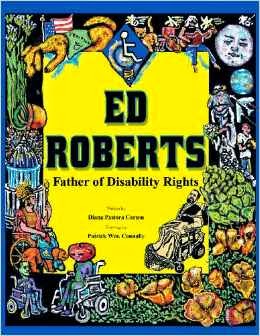
My son's library review of "Ed Roberts: Father of Disability Rights" by Diana Pastora Carson


One of the children's books we have available at our Autism Acceptance Lending Library is "Ed Roberts: Father of Disability Rights" by Diana Pastora Carson.  The book tells the story of Ed Roberts from his childhood, becoming disabled and his advocacy, activism and fight for access and inclusion.   Featuring beautiful and colorful illustrations by Patrick Wm. Connally, this is a wonderful introduction to the man known as the father of the disability rights movement.   This book also has a "symbol" guide near the back of the book to explain some of the symbolism in the illustrations and to open up a dialogue with readers.   This is ideal for a classroom discussion or one on one learning at home.


"They told me I'd be nothing but a vegetable.
Here I am an artichoke.
I choose to be an artichoke all prickly on the outside
with a big, tender heart."
                                 -Ed Roberts


This is my nine year old's review of the book:


My Review by F


Ed Roberts stood up for disability rights. Ed Roberts was not born with a disability but he became disabled when he was fourteen when he contracted polio. He had to stay in an iron lung. His doctors said he couldn't go to college or get a job or even get married. His parents were worried. He went to college anyway. He taught himself school through the phone to graduate from high school. He taught himself how to breathe different so he could leave his iron lung sometimes. He became the director of the Department of Rehabilitation after he went to college. He had to fight a lot when he was in college. He had to fight just to go there, for one thing. I think he probably saw a lot of unfairness and that made him fight harder. He fought all the time harder and harder. Not only that, he got his job being the director of the Department of Rehabilitation after they told him it would be a waste of money to help him. They said that because he was disabled. Ed Roberts proved that people with disabilities had their own rights. People with disabilities are as good as anybody else. Ed Roberts was important in  history because he fought for rights. Laws about disability rights are still evolving to this day. Because of the work he did, we are still fighting. Ed Roberts made life much better for us all.

Saturday, April 12, 2014

Sometimes, I Can't Talk

Talking is not something that I have ever been very good at.   When I am extremely overwhelmed, whether it's sensory stuff (usually lights or too much background noise for me), or whether it's just emotional overwhelm, talking is not something I do well.

I make noises, I even form words.  Except....the words I am saying are not the right words.  I can't find the right words in those moments, so it often comes out with me yelling or saying words that aren't what my brain is thinking    I feel a lot of pressure to talk in those moments because people want to know what is wrong.  There have been numerous times when I even say "I can't talk now" and I am ignored.  This just makes things harder for me.

The questions keep coming.

Talking to me.  Talking at me.

Talking.  Talking.  Talking.

I just want it to STOP.

Unfortunately, very few people in my life respect that I need this to happen so that I can calm down.

So, they continue to talk and ask questions, and pressure me to talk..... and I continue to become escalated and upset.  Because I can talk a lot of the time, they refuse to accept that I can't talk in that moment.  

Honestly, I feel like it's a really selfish thing on their part.  It shows a marked lack of empathy for the way my brain processes information.

It's also extremely frustrating and disrespectful to me.  

If you are talking or interacting with an Autistic person and they ask you to back off, with words, or unspoken language, you need to respect that.  

It's not okay to keep pushing.   Even if you don't understand it.  

Me not being able to talk at some times is not anything I'm doing to you.  It's not an attack on you.  It's not me ignoring or disrespecting you.  It's me doing the best that I can to take care of myself so that I don't escalate.  So that I don't melt down.   It would be really nice if you would let me do that instead of adding to my anxiety.

Acceptance means not just tolerating or acknowledging who I am.  It means that even when you don't understand my reactions or processing, that you respect it.

This is part of me.  It's not easy for me, but making it about YOU certainly isn't helping.